What Percentage of the House of Representatives Is Female
Women volition gain at least xiv seats in the 117th Congress, setting a new tape for female representation.
In 2018, the nation elected 127 women – and 48 women of color – to the House and Senate. Next Jan. iii, at to the lowest degree 141 women, including 51 women of color will be sworn in. Viii races involving women had withal to be called as of Nov. sixteen, meaning this number could still grow.
Women will be at least 27% of the House and 24% of the Senate. The Senate numbers do not include Vice President-elect Kamala Harris, or Kelly Loeffler, a Georgia Republican involved in a runoff that will take place afterward Congress is sworn in. Women make upwardly l.52% of the U.S. population.
A strong showing past Republican women helped bulldoze this trend, with at least 36 serving in the next Congress, compared to 22 currently.
Throughout my 20-plus twelvemonth career every bit a political scientific discipline professor, I've studied women'south representation in mayoral, congressional, gubernatorial and presidential elections.
Here's my look at the female demographics of Congress post-obit the 2022 elections.
In it to win information technology
It is often said that "When women run, women win," and 2022 besides saw record numbers of women running in congressional elections.
In total, 643 women were candidates in congressional primary elections, including a record number of Asian or Pacific Islander, Latina, Middle Eastern or North African and Native American women.
Blackness women also fix a new record in 2022 with 117 entering primaries for the Business firm and xiii for the U.S. Senate, co-ordinate to the Center for American Women and Politics.
Holding onto gains
Many of the women first elected to Congress in 2022 retained their seats.
All four members of "the Squad" were reelected. These women – Ayanna Pressley, Ilhan Omar, Alexandria Ocasio-Cortez and Rashida Tlaib – are Democratic women of color known for their progressive policies, including the Dark-green New Bargain.
Also re-elected were women first elected in 2022 similar Illinois Democrat Lauren Underwood, winner in a predominantly white Republican district; Jahana Hayes, the first Black adult female to represent Connecticut; and Georgia'southward Lucy McBath, Democratic winner in a district that had been held past Republicans for almost 4 decades.
These re-elections prove that their victories in 2018's "pinkish moving ridge" weren't a fluke and that they have real staying power in Congress.
In some 2022 congressional races, African American women ran confronting each other – a sign of their stiff participation. For case, Florida'southward Val Demings, Florida'due south Frederica Wilson and Georgia's Nikema Williams – who will succeed the late ceremonious rights icon John Lewis – won their congressional races after defeating other Black women.
Notable newcomers
The freshman class in the House of Representatives will include at least 26 women serving their kickoff term.
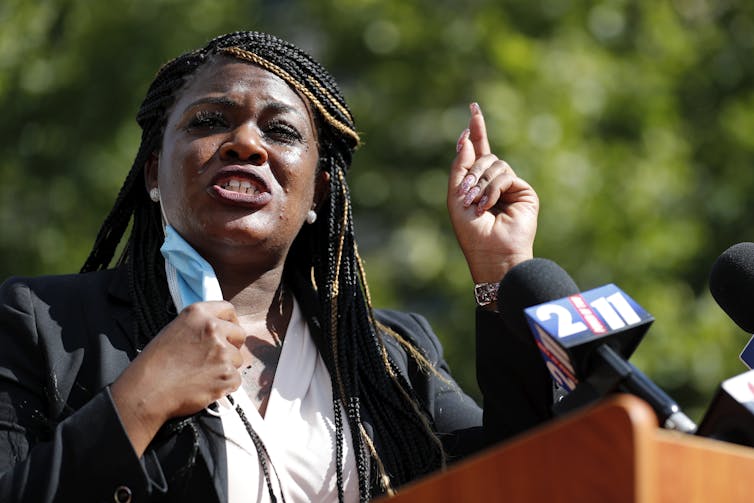
Cori Bush, a Black Lives Thing activist, became Missouri'south showtime Black congresswoman. She represents a district that includes the cities of St. Louis and Ferguson, the site of the law killing of African American teenager Michael Dark-brown in 2014. Ferguson also elected its first Black and first female mayor this year.
Bush defeated African American U.Southward. Rep. William Lacy Dirt. Dirt and his father represented the district for over 50 years.
Other women of color joining the House for the kickoff fourth dimension include former Telemundo journalist Maria Elvira Salazar, a Republican who unseated Donna Shalala in Florida, and attorney Teresa Leger Fernandez, a Democrat from New Mexico.
Marilyn Strickland, the onetime mayor of Tacoma, Washington, will be the first Korean American adult female elected to Congress and the offset Blackness representative from Washington State.
Some underdogs didn't get in
And then who lost?
Arkansas' Joyce Elliott, a quondam teacher and veteran state legislator, came upward brusk in her bid to become the first African American congressional member from Arkansas.
Florida's Pam Keith, a war machine veteran and attorney, lost by a wide margin to her Republican opponent.
Patricia Timmons-Goodson, the beginning African American fellow member of the North Carolina Supreme Court whose federal judicial nomination past Barack Obama was blocked by Republicans, failed to win a seat in Congress.
Also coming up short was Tennessee's Marquita Bradshaw, a unmarried female parent and environmental activist who would have been Tennessee'due south first Black female congressional fellow member if she had won.
California's Tamika Hamilton, Georgia's Vivian Childs, Maryland'southward Kimberly Klacik and Ohio's Lavern Gore are all Republicans who ran in more often than not urban Democratic districts, merely none won on ballot night. All Black female congresswomen – with the exception of Utah's Mia Love, who served two terms in the Firm – have been Democrats, suggesting that the path to victory is especially steep for Black Republican women.
Candace Valenzuela would have become the first Afro Latina in Congress, but lost her race for Texas' 24th congressional district to Republican Beth Van Duyne, a former Trump administration official.
Although they lost, their candidacies hint that more women of color volition continue to run for Congress every bit both Democrats and Republicans and may merely win next time.
A white human'south government?
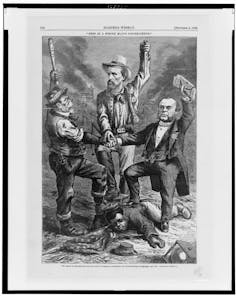
For nearly of its history, the members of both Houses of Congress have been white men.
The monotony began to break in 1916 when Montana's Jeannette Rankin won election as the outset female congresswoman. In 1964, Hawaii's Patsy Mink became the beginning Asian American elected to congress. The commencement Latina, Ileana Ros-Lehtinen of Florida, was elected in 1989.
In 1968, the belatedly Shirley Chisholm became the first Blackness adult female to serve in Congress. Four years afterward, two more Black women arrived in Congress, Barbara Jordan of Texas and Yvonne Brathwaite-Burke of California.
Chisholm chosen Blackness women "catalysts for change" in politics. Rep Maxine Waters, a Democrat from California, in one case tweeted, "I cannot be intimidated and I'm not going anywhere."
[Deep knowledge, daily. Sign up for The Conversation's newsletter.]
Professor Kimberlé Crenshaw'due south theory of intersectionality suggests Black women are discriminated confronting considering of the "intersection" of their racial, gender and class identities. One result is that they encounter disadvantages when running for role.
Some of the women I've mentioned faced disadvantages related to their race, gender or form when running against well-funded incumbents. Nonetheless, my piece of work in the field of women and politics also suggests that the long tradition of Blackness female political leadership in America is gaining momentum. Despite some women's losses, their representation has, and volition continue to, increase in Congress.
Source: https://theconversation.com/a-record-number-of-women-will-serve-in-the-117th-congress-including-at-least-51-women-of-color-149736
0 Response to "What Percentage of the House of Representatives Is Female"
Enviar um comentário