youtube drawing arm 3d printed
At the start of a project, choose a file format that can comprehensively depict the design while suiting the intended applications and minimizing the demand for file conversions. Meshmixer will read numerous 3D file types, such as STL, OBJ, PLY, and some bottom known formats; AMF, 3MF, OFF, and the native MIX format. For exporting designs to a different format, Meshmixer also supports Collada, VRML, and Smesh.
- STL (STereoLithography) is a format originally adult for stereolithography 3D printing that is the nigh commonly accepted file format in 3D printing. Information technology stores but geometry data and has a compact file size.
- OBJ every bit beginning created by Wavefront is a simple format storing vertex data to correspond a 3D mesh. Likewise vertex positions, it also stores surface normal plus a UV coordinate that can be mapped to an external texture.
- PLY (Polygon) is a more all-encompassing format developed at Stanford to aid the storage of 3D scanning data. Ane of its benefits is the possibility to assign properties such every bit texture data separately for both sides of a confront.
- AMF (Additive Manufacturing Format) is an alternative to STL for 3D printing. Beingness XML-based, it will store additional information such as orientation, calibration, patterning multiple objects, non-planar edges, and graded materials.
- 3MF (3D Manufacturing Format) is like to AMF but less standardized as it is created past a consortium of companies. Originally adult by Microsoft, information technology is the native 3D format in Windows.
- OFF (Object File Format) is a unproblematic, hand-programmable, text-based format that next to geometry as well stores color data per vertex.
- Collada (COLLaborative Design Activeness) is a versatile format well-suited for digital avails that was developed by Sony. The now widely supported format allows developers to shop rendering information such as animations, level-of-detail, shaders, also equally diffuse, normal and specularity maps.
- VRML (Virtual Reality Markup Language) is similar to Collada only scriptable and uniform with web browsers.
- Smesh is a elementary format that describes 3D geometry both in terms of triangles and complex polygons. This makes the format more suited for objects with large planar areas.
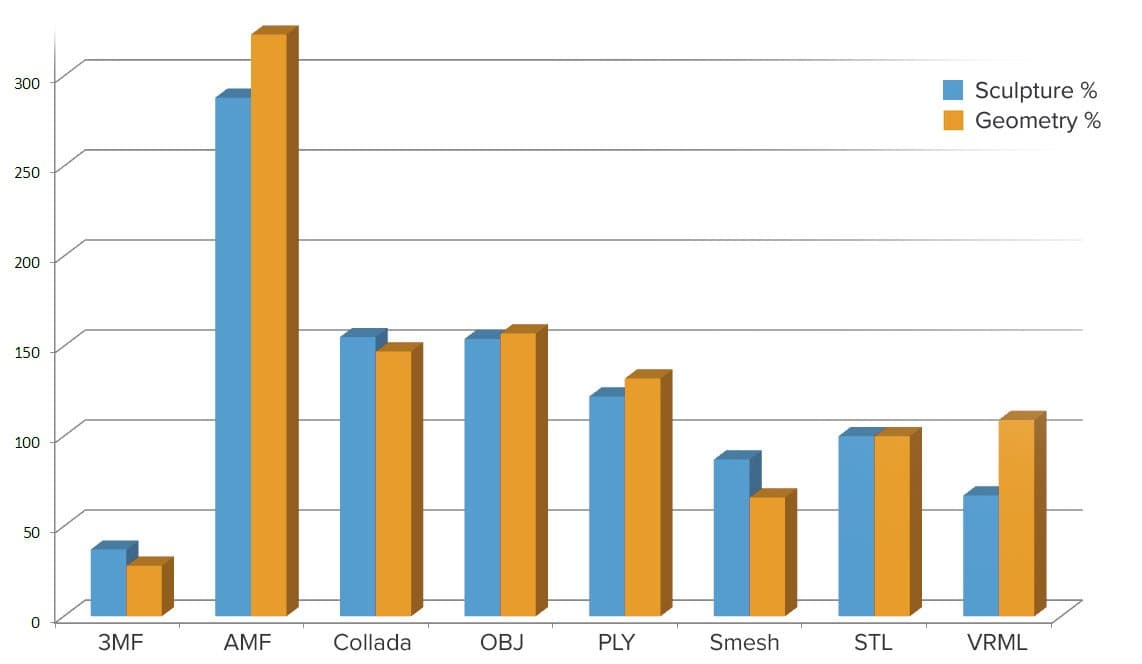
A comparison to the standard STL file format for sculptural and geometrical files reveals that 3MF and Smesh are more than effective formats, while AMF is more than versatile, but also more expensive infinite-wise.
Before modifying a part, make certain to optimize its triangulation. In our example, we picked a model of the Venus of Milo that has an uneven distribution of triangles plus some split and collapsed triangles. With Meshmixer, you can create an fifty-fifty tessellation using the Remesh command.
Click the Select Icon in the menu and click to create an area to be remeshed, or apply Ctrl + A to select the entire object. On the Popup bill of fare, click Edit → Remesh or hit R. In that location are several Remesh Modes:
-
Target Border Length ensures an even triangle size across the mesh, optimizing the part for sculpting. This is computationally intensive and then set a reasonable size relative to the object.
-
Relative Density is the aforementioned method but specifies according to triangle density.
-
Adaptive Density creates a denser triangulation in more detailed areas, optimizing file size. This is helpful when the object is complete and can be saved for 3D press.
-
Linear Subdivision simply creates more triangles by splitting existing ones, maintaining the original geometry.
Note that the Regularity setting creates more equilateral triangles simply sacrifices more detail. The Transition setting creates a gradual transition from the original mesh to the remeshed section. With Preserve Group Boundaries checked the program maintains the shape of specifically designed triangle groups such as perfectly round eyes. Checking the Preserve Sharp Edges pick prevents hard corners from beingness smoothed out. Under Boundary, a Free Purlieus is often preferred because it sacrifices accurateness for mesh quality.
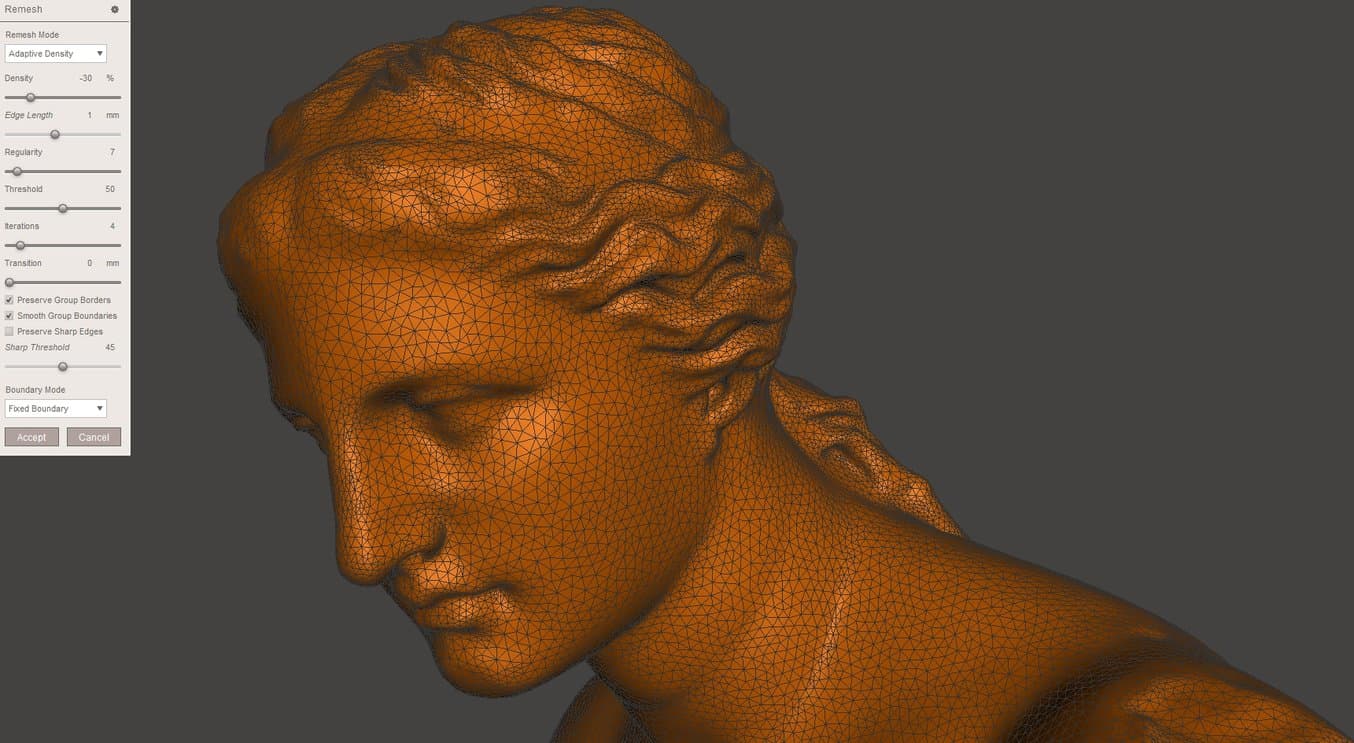
Optimizing the mesh reduced the file size by 60%.
Meshmixer offers several ways to carve up a part of a mesh. The simplest method is first selecting the part to be separated, then using the Edit → Extract (Shift+D) command. The program will create a new shell with an optional offset distance. Choosing the Normal direction for the offset volition expand or shrink your part. Then, from the main menu, option Edit → Separate Shells to individually save and name each part, while deleting obsolete sections.
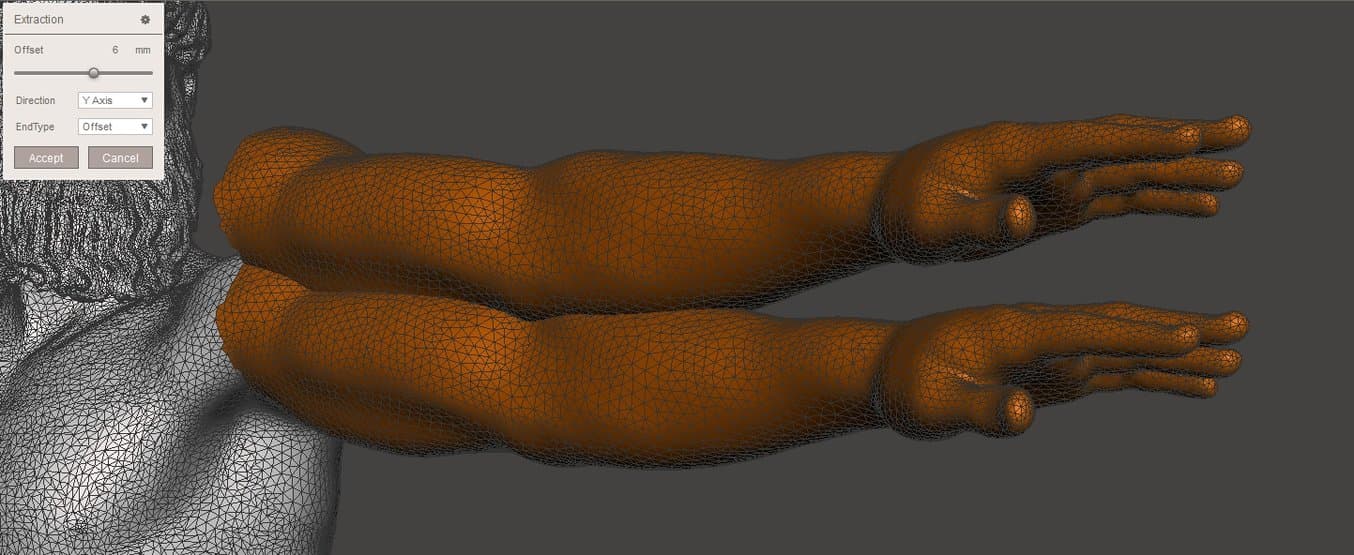
The Extract control creates a indistinguishable or start of a selected area.
The other method is Edit → Plane Cut. This brings up a transform gizmo allowing orientation of the cutting plane. The blue arrow is used to specify cut management. In case a plane would cutting off unwanted sections, it is possible to create a option prior to cut. With the selection active, hitting Edit → Plane Cutting from the pop-upwards rather than from the primary menu.
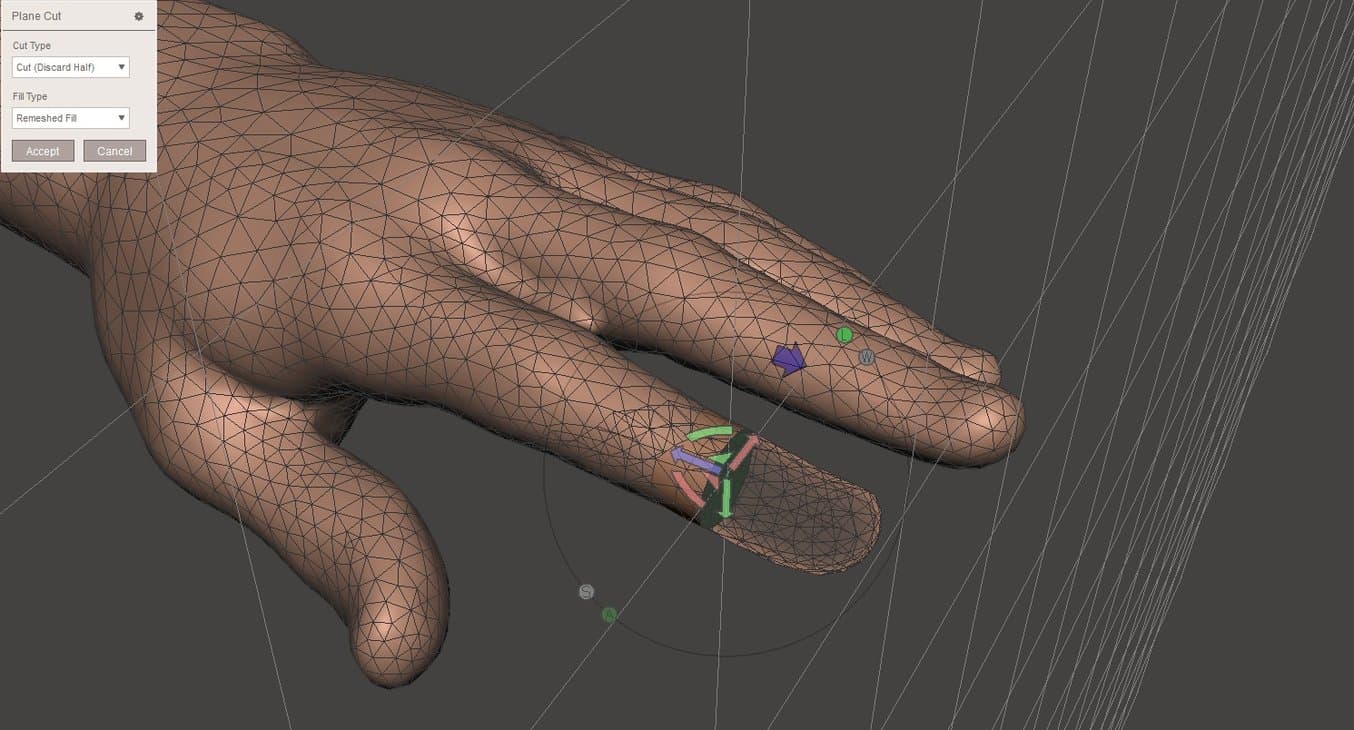
The Aeroplane Cutting command applied to a selection cuts off a specific area without affecting others.
Meshmixer was originally created to interchange and combine different 3D parts. On opening the programme, the get-go icon Meshmix opens up a library of parts. Under the dropdown menu is a section called My Parts. This allows users to create a custom 3D library.
To add an object, select it in the object browser (toggle with Ctrl + Shift + O), and then select all with Ctrl + A. Now in the Select section of the chief menu choose Convert to → Solid Part. Subsequently striking Have the object will be visible in the My Parts section.
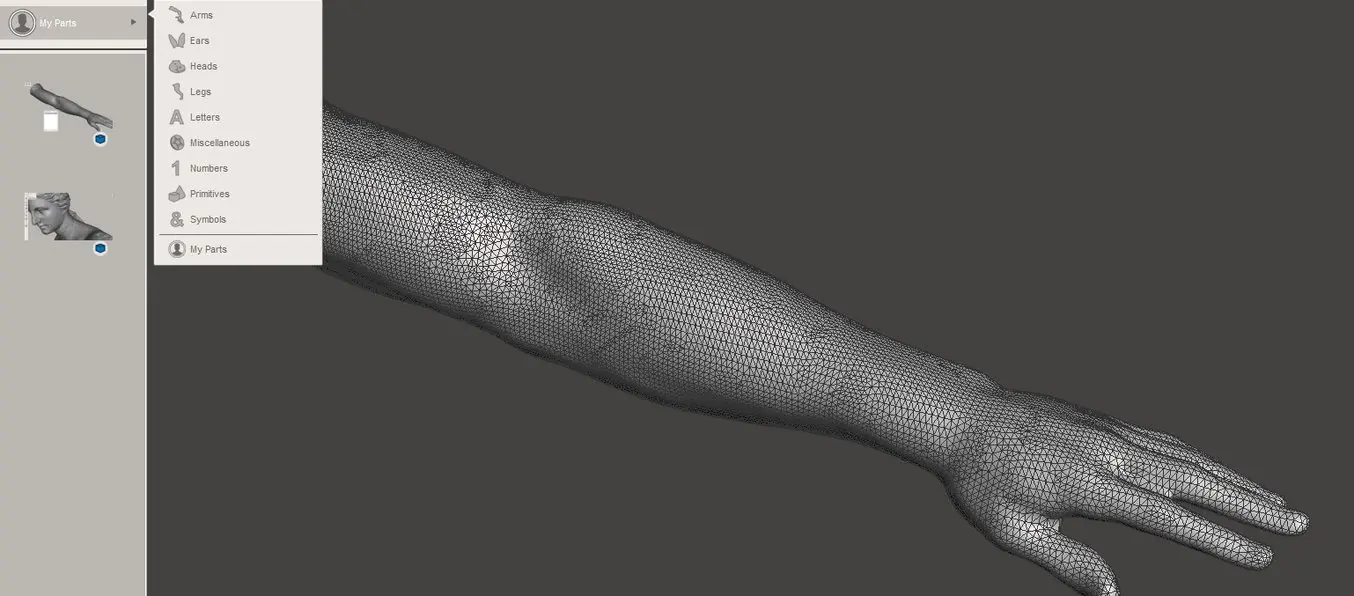
My Parts lets users create a custom object library.
In the Sculpt section, Meshmixer offers several brushes that can exist applied directly to the mesh. The following Volume brushes offer all the functionality required for basic 3D sculpting work:
-
Drag moves an area in 3D space
-
Depict displaces vertices along the normal of the castor region, every bit if drawing on the surface
-
Flatten moves vertices in the brush region towards the average normal of that area
-
Inflate translates vertices forth their normal
Drag moves an expanse in 3D space
Draw displaces vertices along the normal of the brush region, equally if cartoon on the surface
Flatten moves vertices in the brush region towards the average normal of that surface area
Inflate translates vertices along their normal
Belongings Ctrl while sculpting inverts the castor function, i.e., deflating instead of inflating and debossing instead of drawing. Apace modify castor size with the straight bracket ( [ and ] ) hotkeys, or cycle through concluding used brushes with the left and right arrows. The recommended secondary brush is RobustSmooth which is activated past belongings Shift. This way, the sculptor can speedily alternating between manipulation and smoothing brushes to define the overall book.
For adding detail, the Depict brush with a spiky falloff design works well. Together with the Pinch brush, this results in very precipitous lines. Surface brushes are smashing for calculation item as well. The use of custom stencils allows rapid creation of intricate textures. Brand sure to Enable Refinement (hotkey R) or use the Refine Brush in the Volume section to add triangles for boosted detail.
Checking Symmetry (hotkey Shift + Southward) applies the identical sculpting performance across a symmetry plane. When checked, hit the toolbox icon next to the command to manually place the symmetry aeroplane.
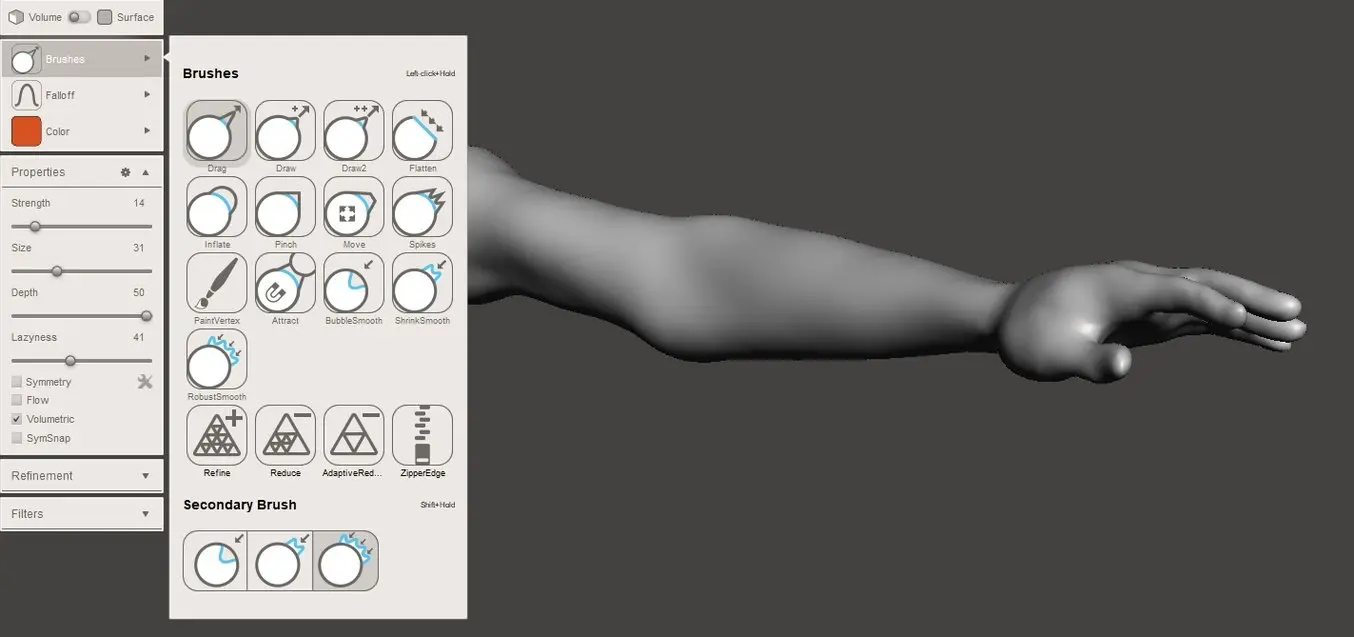
Basic book brushes transformed this arm model into a softer one that will fit our Venus of Milo model improve.
To combine two meshes into one, import both meshes or elevate them from the Meshmix library. In the Object Browser, select an object from the primary card and choose Edit → Transform to position each object. With both objects selected, start the appropriate Boolean command, in this example, Wedlock. This is a complex algorithm that merges the two objects into a single shell. In instance the object consists of multiple shells, offset apply the Edit → Separate Shells command. For a Boolean Divergence command, the 2nd selected object is subtracted from the offset. Considering of Meshmixer'due south unique version of the Boolean script, it not only works on solid models merely besides on surfaces.
Precise or Max Quality fashion volition maintain the intersection curve between both objects, while Fast Approximate is much quicker and unremarkably suffices. If the Boolean operation fails information technology results in two red colored objects. In that case, plow the Search Depth parameter upwardly to increment the chance of success. Checking Use Intersection Curves besides improves quality. Target Edge Scale controls the size of the triangles near the intersection relative to the surrounding ones.
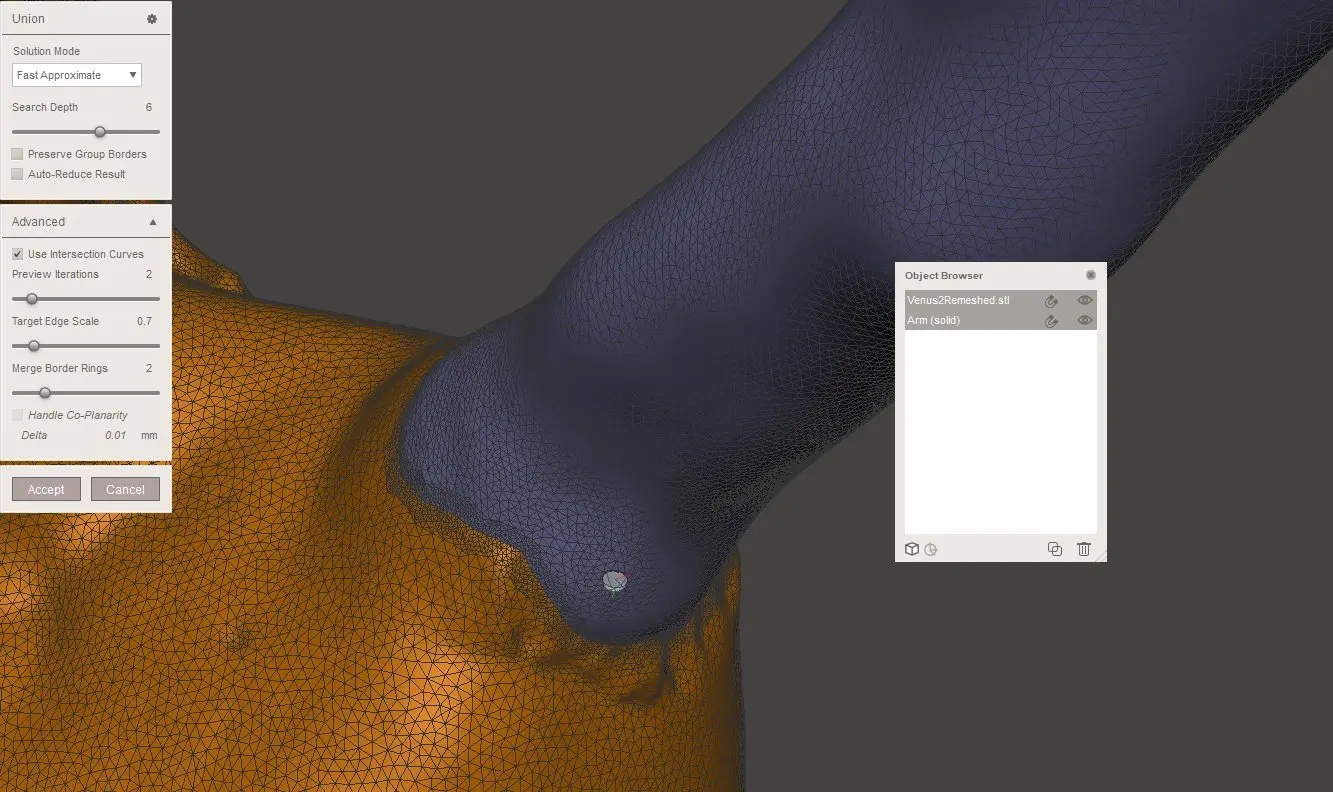
A successful Meshmix with added item at the intersection for resculpting.
Meshmixer offers several advanced means of patching up holes in a mesh. Sometimes it is useful to create a pigsty in gild to cut out an irregular expanse. In that case, enter Select fashion and utilize the lasso to select the area to be removed. Now hit Delete or Edit → Discard (X) to remove all selected faces. Get to Assay → Inspector and the hole will be detected. Of the available options in the dropdown carte du jour, Minimal Fill results in the least amount of triangles necessary to shut the hole. A Flat Fill creates a patch as flat equally possible, and a Polish Fill matches the patch to the curvature of the surrounding area. Motorcar Repair All usually fixes all holes, as well equally intersecting and floating triangles.
An alternative method is to select the area to exist deleted and utilize the Edit → Erase and Fill (F) operation from the popup carte du jour. Setting Type to Polish MVC results in a good continuous fill up. Edit → Make Solid or Edit → Replace and Fill are other methods that will fill all holes. An additional laissez passer with the RobustSmooth sculpting brush will blend the improved surface area completely into the model.
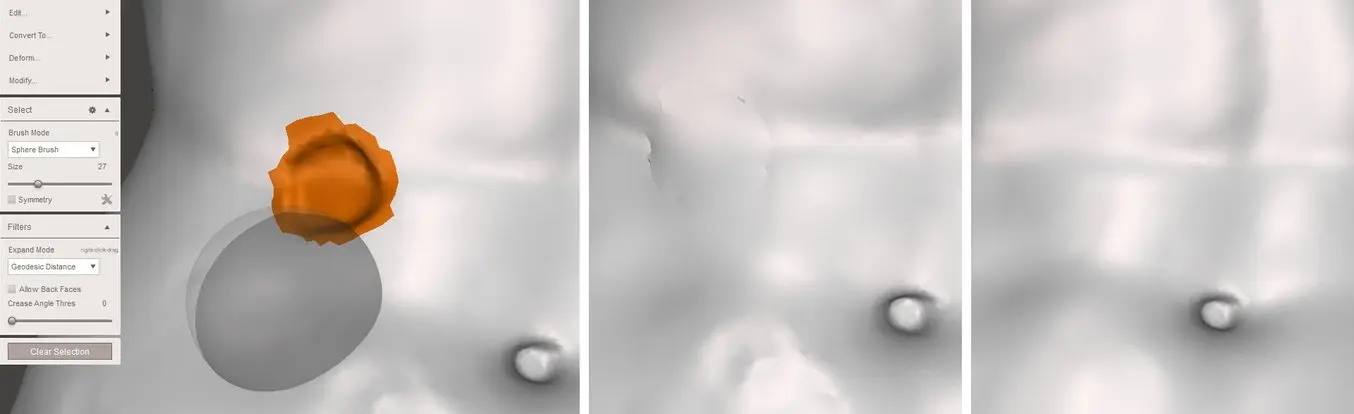
Smoothing out irregular areas.
For whatsoever feature to be visible later on 3D printing, it needs to have a minimum wall thickness or particular size, that'southward dependent on the 3D printer and 3D printing technology. Stereolithography 3D printers, like the Form 3, can reproduce some of the finest details.
Ane way to add together thickness to a mesh lies in a specific use of the Extrude control. Select the surface area that needs thickening using Castor fashion, which allows selecting (and deselecting by holding Ctrl) individual triangles. It is possible to smooth the selection by choosingAlter → Shine Purlieus from the popup card. Increasing the Smoothness and Iterations parameters will event in a more than make clean selection. Now, choose Edit → Extrude (D) with Normal every bit the Direction setting.
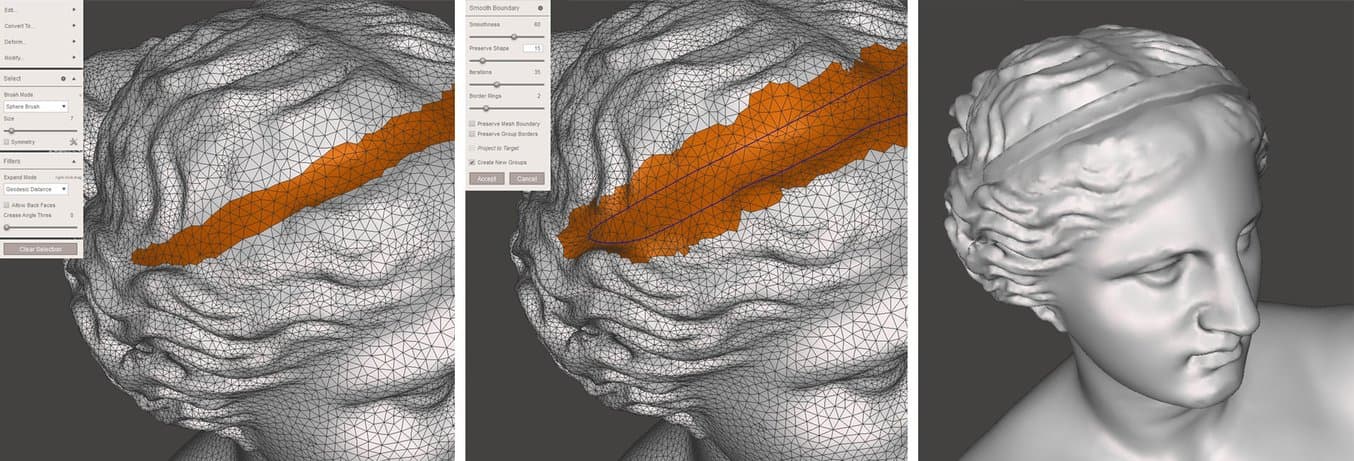
Generating a thicker section with the Extrude operation.
At times when yous're not printing functional parts that require a certain force, adding wall thickness to hollow out your design tin can exist a great fashion to save a considerable corporeality of material and time.
To install a wall thickness to the entire model, choose Edit → Hollow. The minimum wall thickness depends on the 3D printing engineering. For both SLA and selective laser sintering (SLS), i mm is a good minimum get-go value.
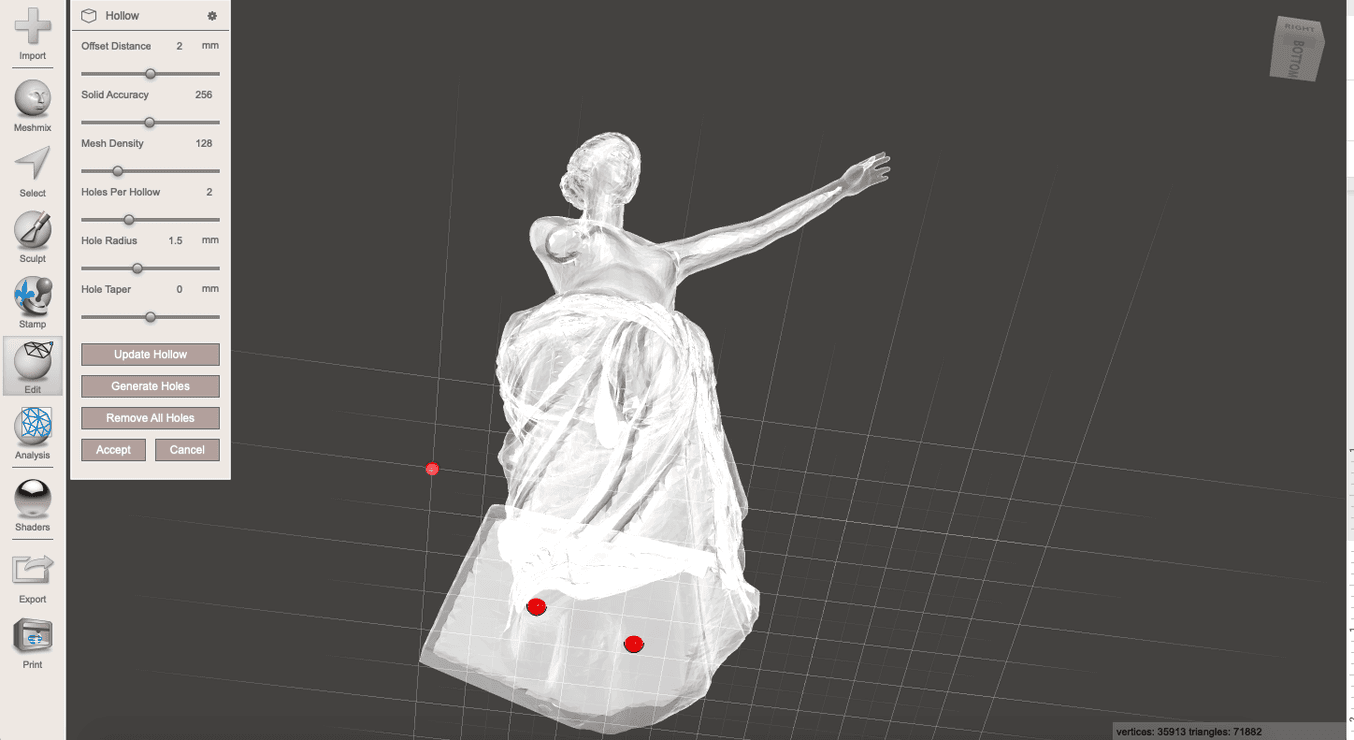
Calculation escape holes when hollowing out parts is crucial for successful 3D printing with SLA and SLS technologies.
For SLA, include at least two holes with 1.5 mm diameter—i closest equally possible to the build platform, the other somewhere on an opposite side. This provides an escape hole for the resin, preventing a force per unit area differential during the 3D printing process. It besides ensures practiced isopropyl booze (IPA) flow during cleaning and air venting later on.
For SLS models, add two 2 mm holes or one hole with a 4 mm bore for the entrapped powder to escape. It is possible to Generate Holes automatically or double-click to specify custom locations.
To ensure a watertight model, run Edit → Make Solid after creating holes. This is an intensive operation so make sure the model is now set for 3D printing.
Using the Assay → Stability tool we can too conclude that the object volume has been reduced by more than than 75% in our example case that'll significantly reduce fabric utilize and printing fourth dimension.
Utilize Analysis → Thickness to verify if the wall thickness of the model is within adequate limits for the given 3D printing technology. Not sufficient wall thickness might lead to lost details, or, in a worse case, impress failure.
The Minimum Thickness setting checks if the wall thickness meets this dimension, and Minimum Defect Size indicates the minimum size the area needs to have to be marked equally beneath the threshold. Cone Angle, Cone Samples, and Grazing Bending are technical parameters relating to the number of rays calculated from i side to the other and the angle between them in gild to decide wall thickness. Lowering the cone samples and setting a college grazing angle will better processing times.
Analyzing our unmarried-armed Venus model, at that place are some areas of low wall thickness, just with SLA 3D printing, only the largest ones on the tunic will demand modification, for instance using the Inflate brush.
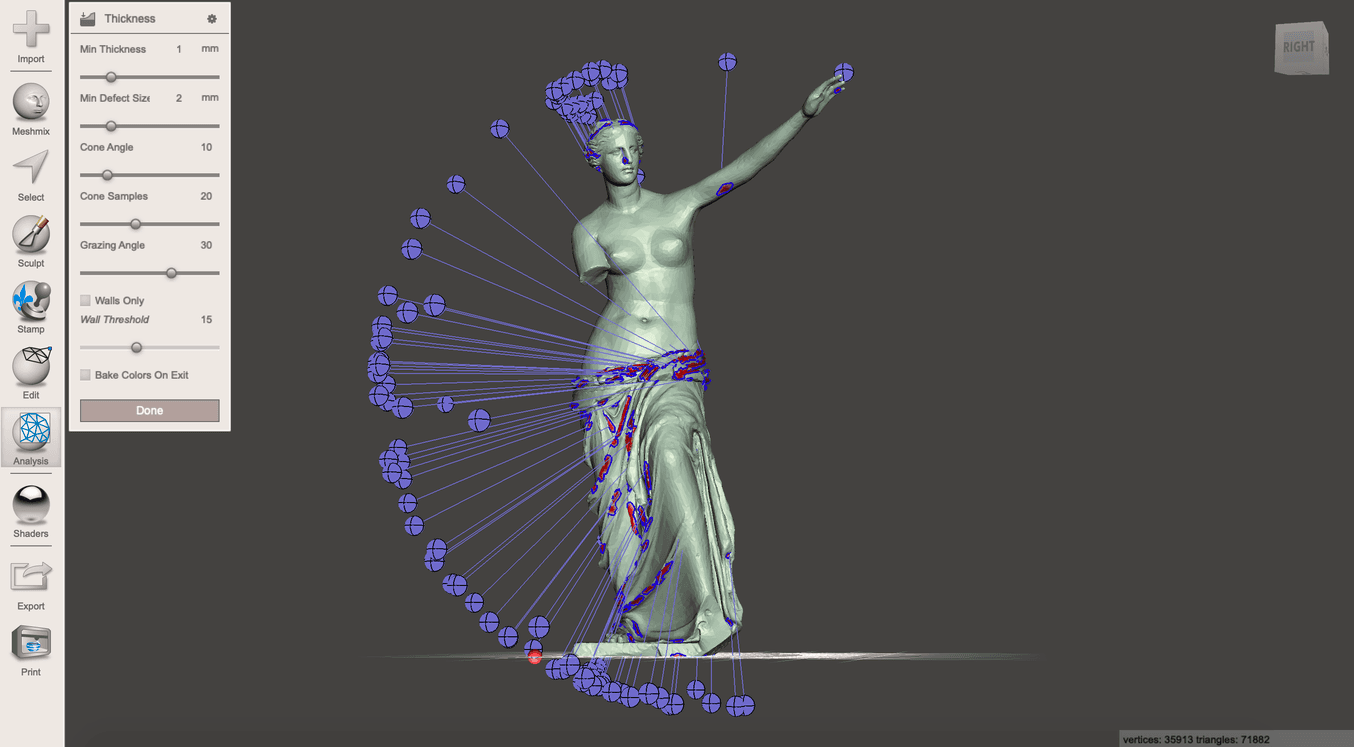
Wall thickness assay volition assistance to preserve details and reduce print failures.
Non surprisingly, our Venus sculpture was not created with 3D printing blueprint rules in listen more than two,000 years ago. For successful printing, fused deposition modeling (FDM) and SLA 3D printers will crave support structures. Meshmixer offers the possibility to embed back up structures directly into the mesh. They are constructed using bifurcating strands that grow upwardly to the overhang, which can save enough of material compared to raft-based supports.
Avant-garde impress grooming tools like Formlabs' PreForm software allow you to create and edit optimal back up structures with ease for the selected printer and 3D model. For best results, we recommend using PreForm to create support structures. PreForm is gratuitous, try it now.
From the chief menu, pick Analysis → Overhangs and select a preset pertaining to the 3D printer. Calculation a Contact Tolerance specifies the altitude from the tip of the support structure to the model in order to facilitate breakaway. Now open up the Support Generator that presents us with settings that speak for themselves. Under Advanced Back up make certain to check Let Acme Connections for models requiring tall support structures. This will create supports that start somewhere on the model itself rather than starting from the build plate. After tweaking the settings, hit Generate Supports. The support generator is computationally intensive so for big models it is sometimes useful to perform another Edit → Remesh or Edit → Reduce operation to minimize triangle count. It as well helps to have the model already positioned with the Z-axis upwardly and snapped to the XY-plane. Use Ctrl + LMB to remove private supports in areas of high detail where they might interfere with the product geometry, are prone to fail to print, or volition exist hard to remove mail service-printing.
With all support structures in place, Convert to Solid combines all connected supports into a unmarried object. The Edit → Dissever Shells control then allows saving support structures separately from the model in guild to utilize dissimilar 3D printing settings in the slicer software.
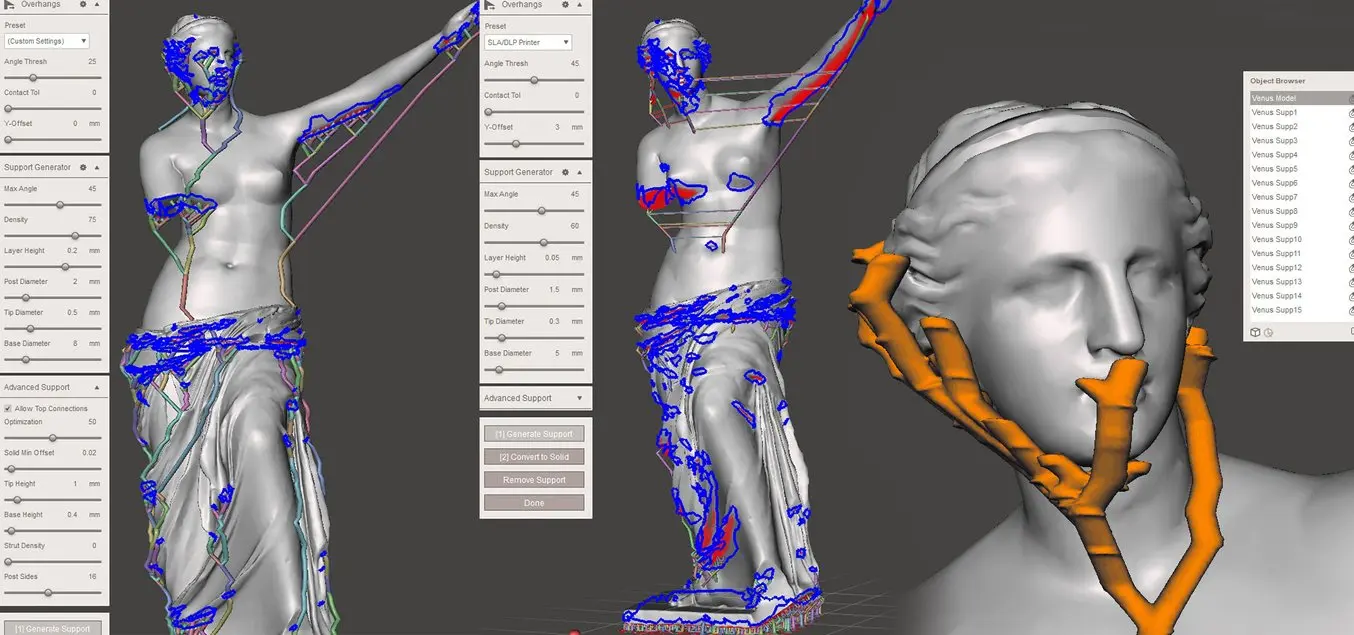
Support structures generated for FDM and SLA 3D printing can bereduced to the bare minimum in highly detailed areas.
Calculation wires to a 3D model, for instance, for connecting multiple parts in a single print, tin can take substantial effort if done manually. Delegating this part of the modeling process to MeshMixer will event in a successful model when using the powerful Edit → AddTube tool. This allows the user to specify 2 points on the mesh surface between which a tube of specified start and finish radius gets connected. The Spline blazon allows curving the tube along the start and the cease confront normal, with tunable tangent forcefulness. AutoRoute (Smooth) creates a tube that as far as possible passes through the model which is useful for fluid channels or electric wiring routes.
When choosing Boolean in Combine Way, an outside tube is added to the mesh while an inside tube gets subtracted to create an internal channel. Append creates a new shell inside the same object without merging with it.
In case we desire to create an array of miniature objects connected by ways of a sprue-blazon connection, Edit → Transform (T) and Edit → Mirror are useful to scale down and reposition them. With Edit → Marshal the object can be snapped to the ground plane. Hit Edit → Duplicate and with the new object selected in the object browser, use the Transform tool to move it along the X-centrality. Select the 2 objects and perform a Combine operation to move the models into a single object and create linear patterns speedily. For more advanced object patterning functions, it's all-time to use other software tools, such equally Blender'south Array Modifier.
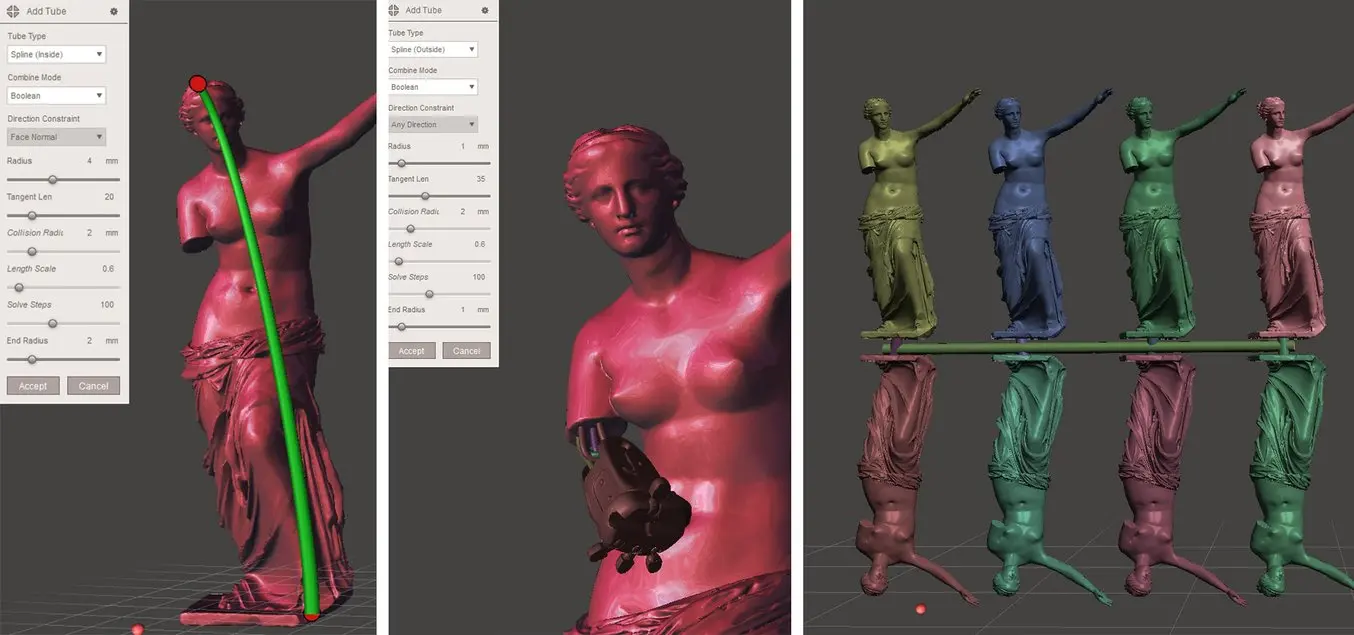
Different uses of the AddTube tool.
When printing multiple objects, it is of import to brand efficient utilize of the available space. MeshMixer offers the Analysis → Layout/Packing functionality to layout objects in different means. It is important to apply the Separate Shells command and correctly orient the objects relative to the basis plane before starting the packing algorithm. For our Venus sculpture, a Square Packing Style proved more efficient than a Circular Packing Fashion.
MeshMixer's Packing algorithm optimizes the layout to save infinite when 3D printing multiple objects.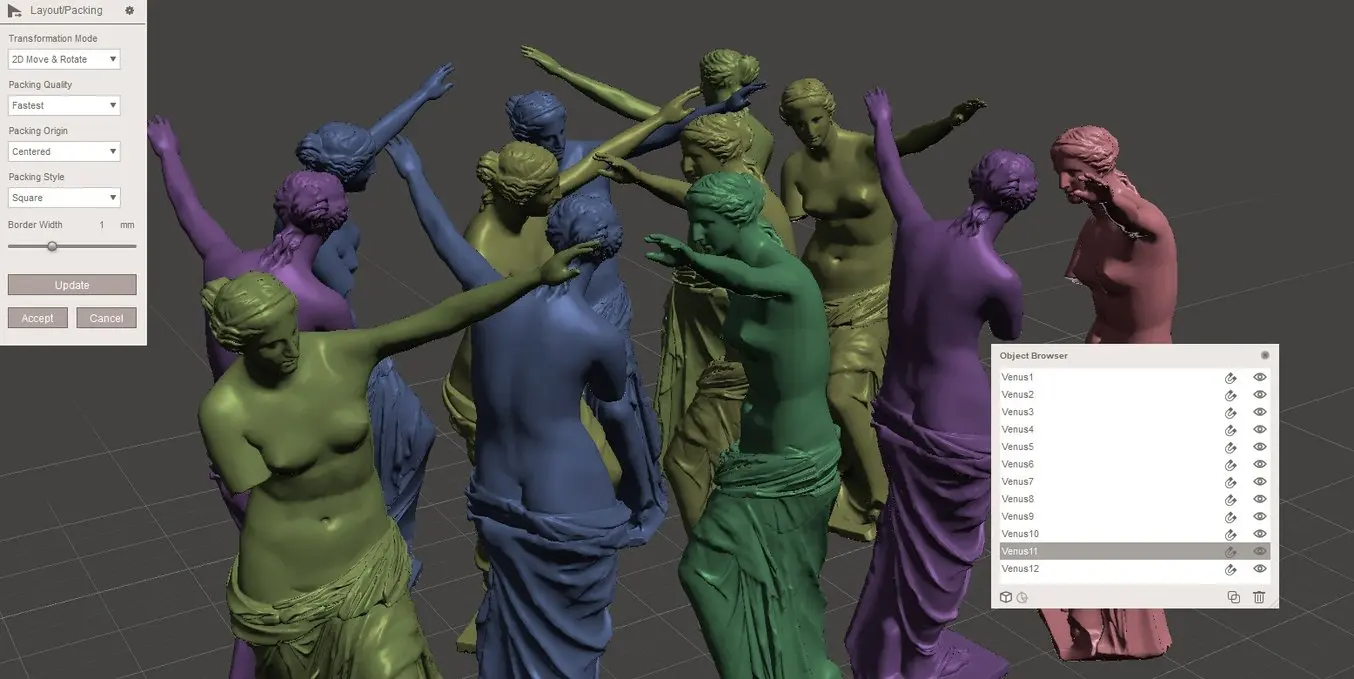
Meshmixer also features a list of stylistic variation to allow designers to get creative when editing meshes.
Voxelize
The Edit → Make Solid control from the main menu creates a watertight solid from mesh surfaces past recomputing the object into a voxel representation. If we opt for Blocky mode under Solid Type with large cell size, it results in a funky voxelized model. To foreclose straight overhangs that need support structures, the trick is to start rotate the object by 45 degrees over the X or Z-axis using the Edit → Transform tool. Utilise Edit → Plane Cut to brand the bottom apartment again.
Depression Poly
Making expert depression polygonal models is an art that often requires many hours of manual design work. MeshMixer provides advanced functionality to plow even complex objects into striking depression poly pieces. This can be done in two passes:
-
First, make up one's mind the minimum triangle size necessary to preserve detail. This removes unnecessary detail which speeds up experimentation in the 2nd laissez passer. Click Edit → Remesh and choose Relative Density mode. Turn downwardly the Density slider to where the geometry is still reasonably represented, with the Preserve Sharp Edges option left unchecked.
-
Hitting Accept and again cull Edit → Remesh. This time, utilise the Target Edge Length style to specify the length of the longest edge required in the low poly model under Edge Length. At present check Preserve Sharp Edges and experiment with the Sharp Threshold and Regularity parameters until the model looks similar an creative version of the original i.
Kickoff, make up one's mind the minimum triangle size necessary to preserve item. This removes unnecessary item which speeds up experimentation in the 2d pass. Click Edit → Remesh and choose Relative Density mode. Turn down the Density slider to where the geometry is still reasonably represented, with the Preserve Sharp Edges option left unchecked.
Hit Accept and again choose Edit → Remesh. This time, apply the Target Border Length mode to specify the length of the longest edge required in the low poly model nether Border Length. At present check Preserve Sharp Edges and experiment with the Abrupt Threshold and Regularity parameters until the model looks like an creative version of the original ane.
Wireframe
An open wireframe-way model tin can be created afterward start applying the commencement Remesh pass described in the Low Poly section. And then selection Edit → Brand Pattern from the primary menu and choose Edges for Design Type. This creates a wire at every edge. Choose Dual Edges for a Voronoi-style design. Element Dimension represents the wire diameter, which should be at least ii or two.v mm for FDM 3D printing and i mm for SLS and SLA 3D press. Grid Smoothing is an advanced choice that will smoothly blend all wireframe components, resulting in a visually and mechanically more bonny pattern.
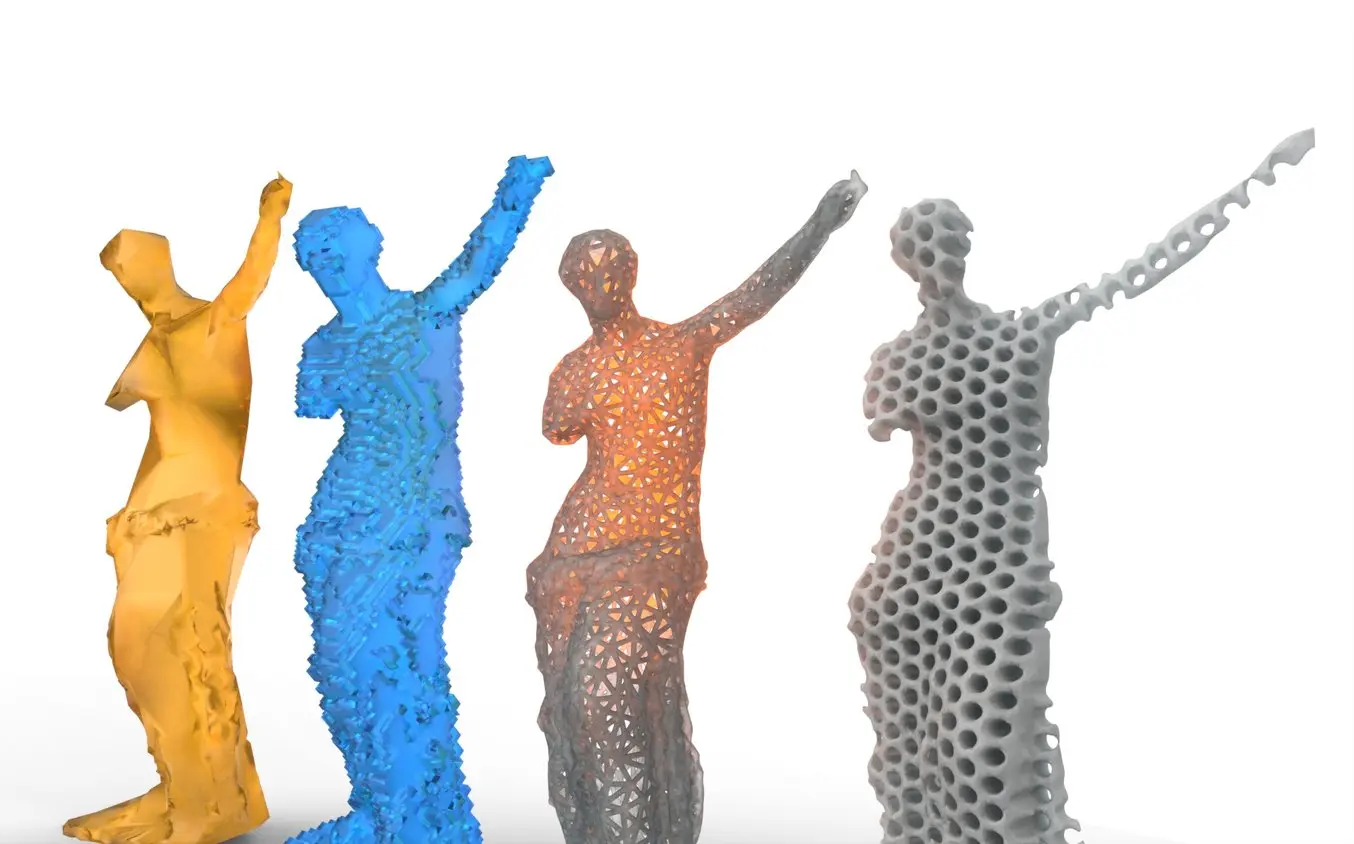
Low-poly, voxelized, wireframe, and perforated pattern variations.
Using the Impress command from the primary menu, you can gear up printer properties and pick the print training tool or slicing program to slice the model and ship it straight to the 3D printer.
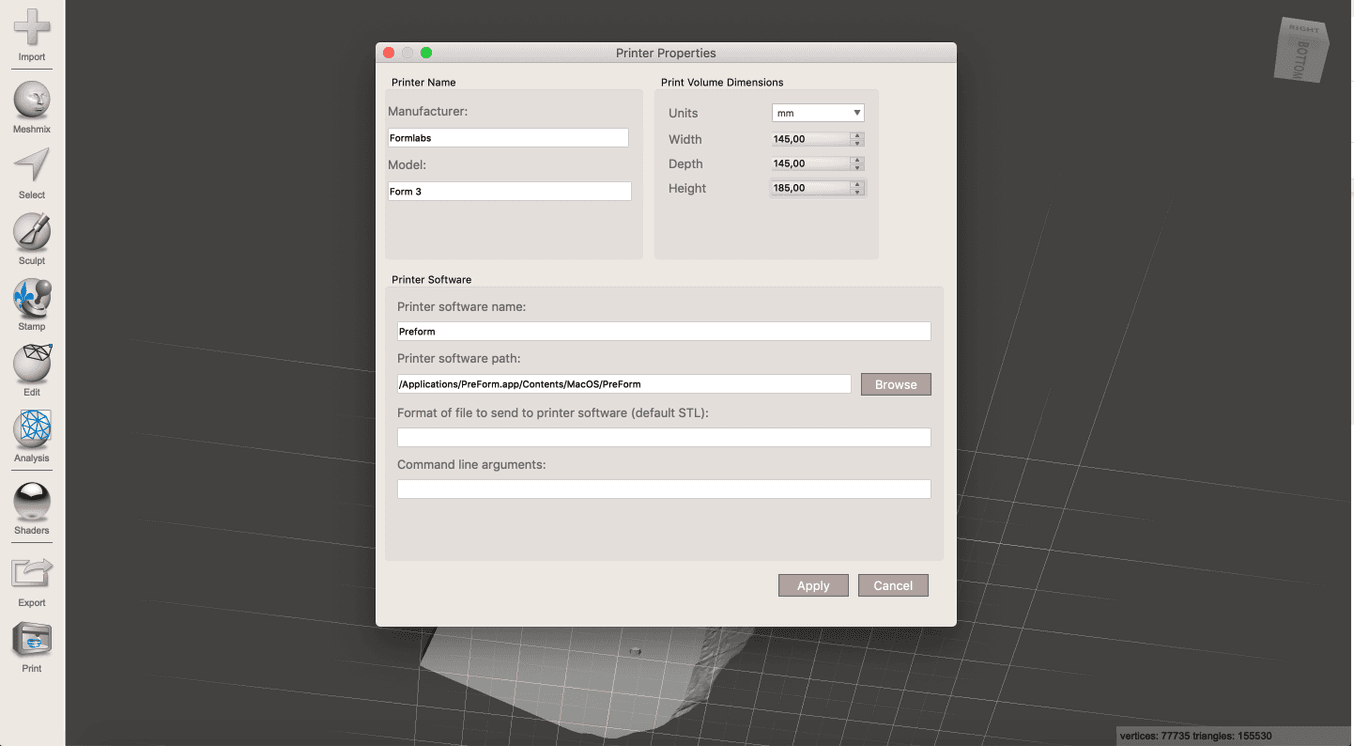
Setting up printer backdrop in Meshmixer speeds upward the workflow.
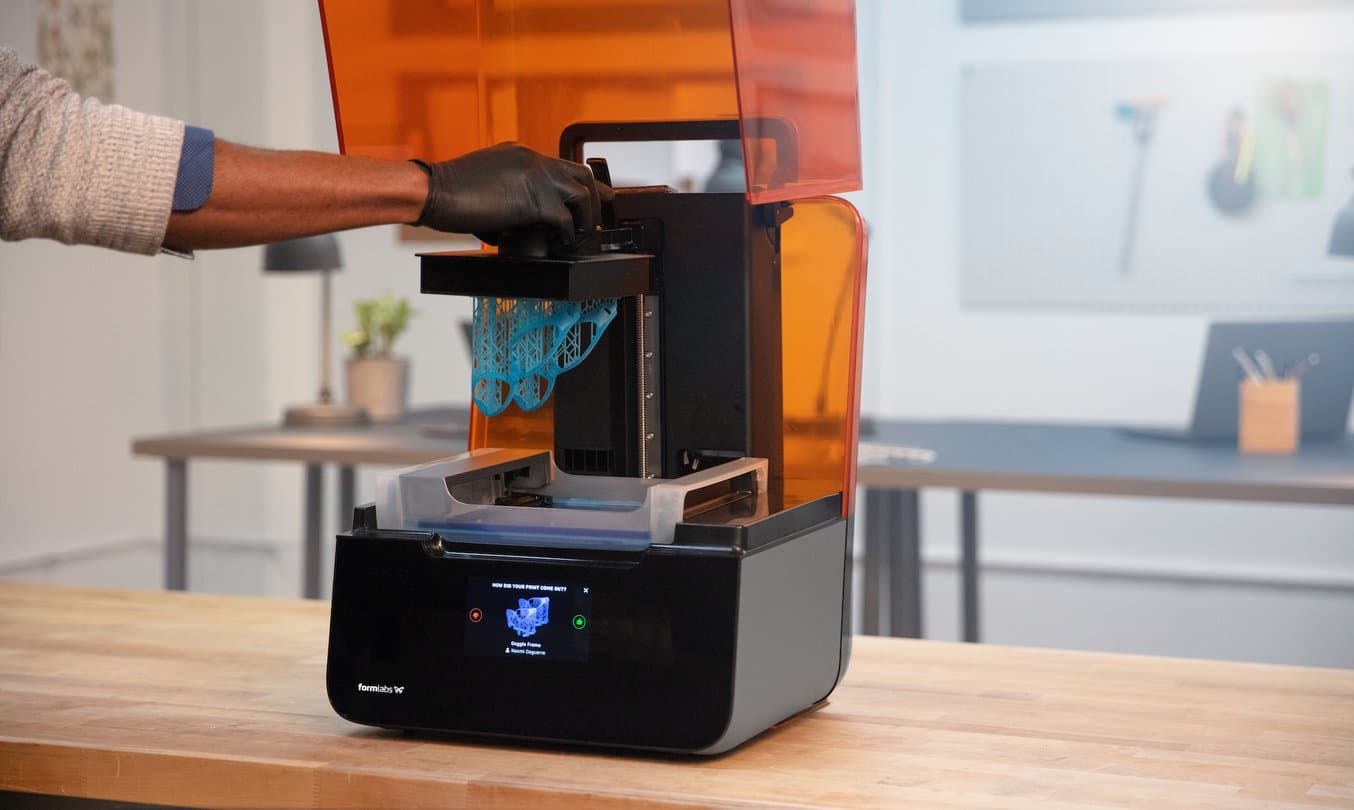
Looking for the correct tool to turn your designs into reality? High-resolution desktop stereolithography 3D printers are fast and cost-effective tools to produce loftier particular models with a smooth surface finish.
Learn more than almost SLA 3D printers and see the quality firsthand by requesting a complimentary sample part printed on a Formlabs SLA 3D printer.
Source: https://formlabs.com/blog/meshmixer-tutorial-tips-to-edit-stl-files-for-3d-printing/
0 Response to "youtube drawing arm 3d printed"
Enviar um comentário